

$100M Money Models
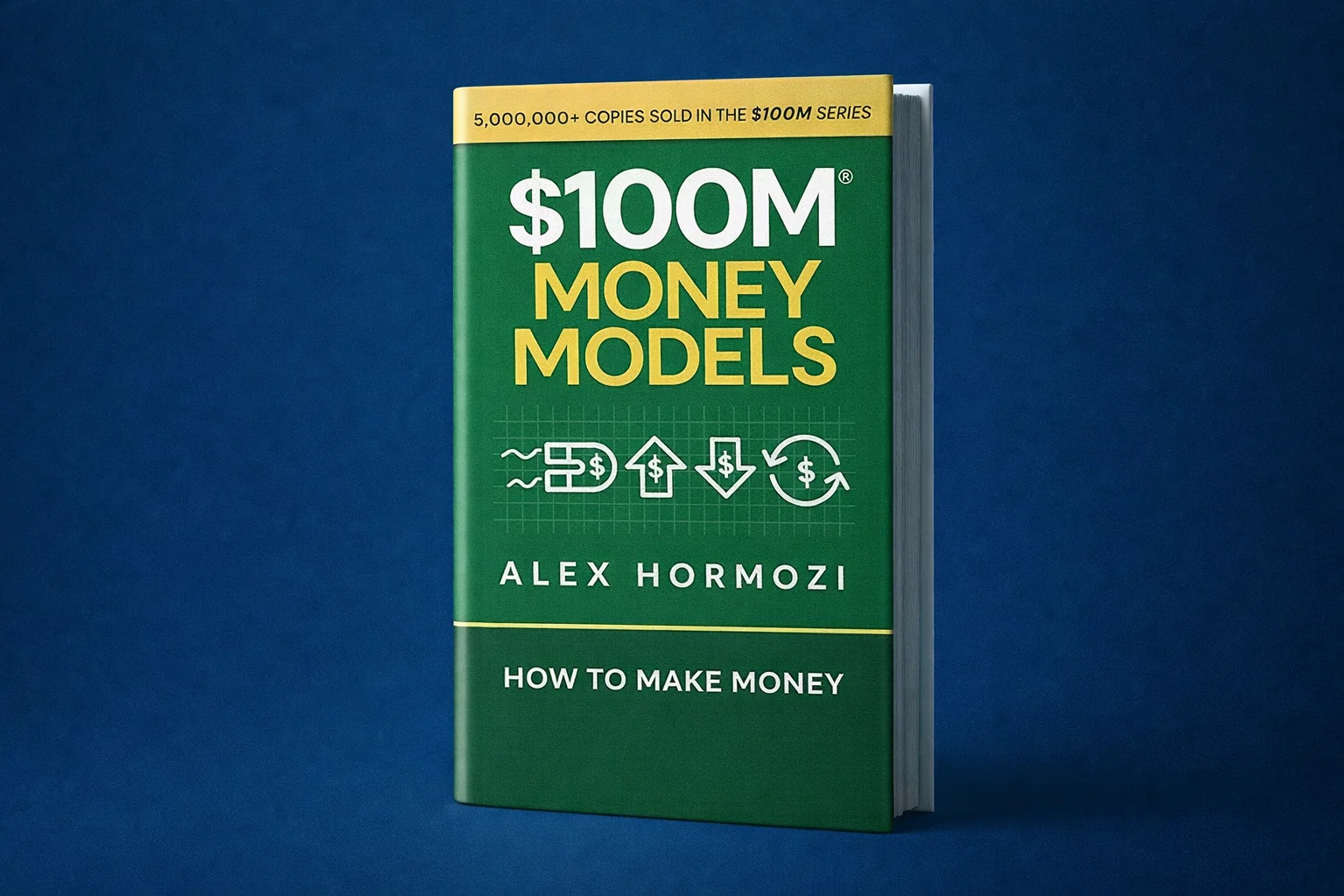
Most business owners are trapped in a cycle of high acquisition costs and low profits. They spend more to get a customer than they make on the first sale. Alex Hormozi’s latest masterclass, $100M Money Models, provides the blueprint to flip this script and build a business that is profitable from day one.
For most business owners, the math is brutal: it costs more to acquire a new customer than you make from their first purchase. This creates a painful cash flow crunch. You spend money to get customers, only to realize you spent more than you made. You cut back on advertising, get fewer customers, and find yourself forced to float the business with personal cash, loans, and credit… and then pray for profit.
It’s a cycle that starves businesses and leads them to fail. But it doesn’t have to be that way.
Alex Hormozi, an entrepreneur who went from sleeping on a gym floor to building a $100M net worth by age 31, has a different approach. His book, $100M Money Models, is a masterclass in structuring offers to make money from the very first interaction with a customer. His strategies are powerful, practical, and often completely counter-intuitive.
This article distills four of the most surprising and impactful ideas from his work that can fundamentally change how you think about making a profit.
1. The “Free” Illusion: How a Free Offer Can Instantly Generate Profit
The intuitive answer to “How much does a free offer cost?” is usually “nothing.” But Hormozi argues that a well-structured free offer is actually a gateway to immediate revenue.
The Concept of “Problem-Stacking”
Hormozi shares the story of a storage unit business that offers the first month for free. While the unit is free, the customer immediately faces a series of new problems that require paid solutions:
- Security: You need a high-security lock ($47).
- Organization: You need boxes, tape, and labels.
- Logistics: You need to rent dollies or straps.
- Protection: You need to upgrade your insurance policy.
By identifying and monopolizing the solutions to the chain of problems every new customer faces, a “free” customer can instantly turn into $127 of profit. The strategic leap is moving from selling a single product to selling a complete solution for the sequence of problems your initial offer creates.
2. The Level-Up Principle: Is Your Skill Trapped?
A world-class skill applied to a low-ceiling opportunity will always yield mediocre results. Hormozi learned this after paying a marketer $25,000 for an hour of advice.
Level-10 Skill vs. Level-2 Opportunity
At the time, Hormozi was successfully opening gyms with zero debt. He expected praise, but the marketer told him: “Alex, you have a level-10 skill in a level-2 opportunity.” The realization was that his true talent wasn’t in operating gyms, but in the system he created to launch them. By pivoting to teaching other gym owners his system (founding Gym Launch), he applied his skill to a higher-leverage opportunity, which eventually led to his $100M net worth.
3. The Anchor Effect: Using Price Framing to Increase Value
Most businesses are terrified of high prices, but starting too low is often a bigger mistake. Hormozi explains that “The only thing worse than making a $1,000 offer to a person with a $100 budget is making a $100 offer to someone with a $1,000 budget.”
The “Anchor Upsell” Strategy
By presenting a premium, high-priced option first (the Anchor), your main offer appears far more reasonable.
- The Example: A salesperson shows you a $16,000 suit first. When they later show you a $2,200 suit, it feels like a fantastic deal—even if your original budget was $500.
This technique re-frames the customer’s perception of value. They walk away feeling like they secured a smart deal, while you maximize the transaction value.
4. The Power of “Unselling”: Building Trust by Saying No
Trust is the most valuable currency in sales. One of the fastest ways to build it is through “unselling”—telling customers what they shouldn’t buy.
Becoming a Trusted Advisor
When Hormozi was selling supplements, he would look at a customer’s goals and dramatically cross off items from the list that they didn’t need.
- “You’re not trying to gain weight, right? Then you definitely don’t need this.”
This simple act transforms you from a pushy salesperson into a trusted advisor. When you finally make a “prescription” (the recommendation of what they do need), the customer buys without hesitation because the trust has already been established.
Conclusion: It’s Not a Sale, It’s a System
The core lesson from $100M Money Models is that sustainable wealth isn’t about a single magic offer. It’s about designing a thoughtful sequence of offers—a “Money Model”—that guides the customer and solves their evolving problems.
As Hormozi says: “Remember—we don’t get customers to make a sale, we make sales to get customers.”
About the Author: Alex Hormozi
Alex Hormozi is an American entrepreneur, investor, and philanthropist. He is the co-founder of Acquisition.com, a holding company that invests in and scales high-growth companies. Starting with a single brick-and-mortar gym, Hormozi eventually scaled a portfolio of companies that exceeded $100 million in annual revenue. He is widely recognized for his “no-nonsense” approach to business growth and his bestselling books, including $100M Offers and $100M Leads. Together with his wife, Leila Hormozi, he focuses on sharing the business frameworks that allow entrepreneurs to achieve “unreasonable” success.
Book Details
- Title: $100M Money Models
- Explanatory Title: How to make money by structuring high-leverage offers
- Author: Alex Hormozi
- Publisher: Acquisition.com
- Publication Date: July 2024
- Print Length: 230 pages
- Category: Business / Marketing / Sales & Entrepreneurship