

Company of One
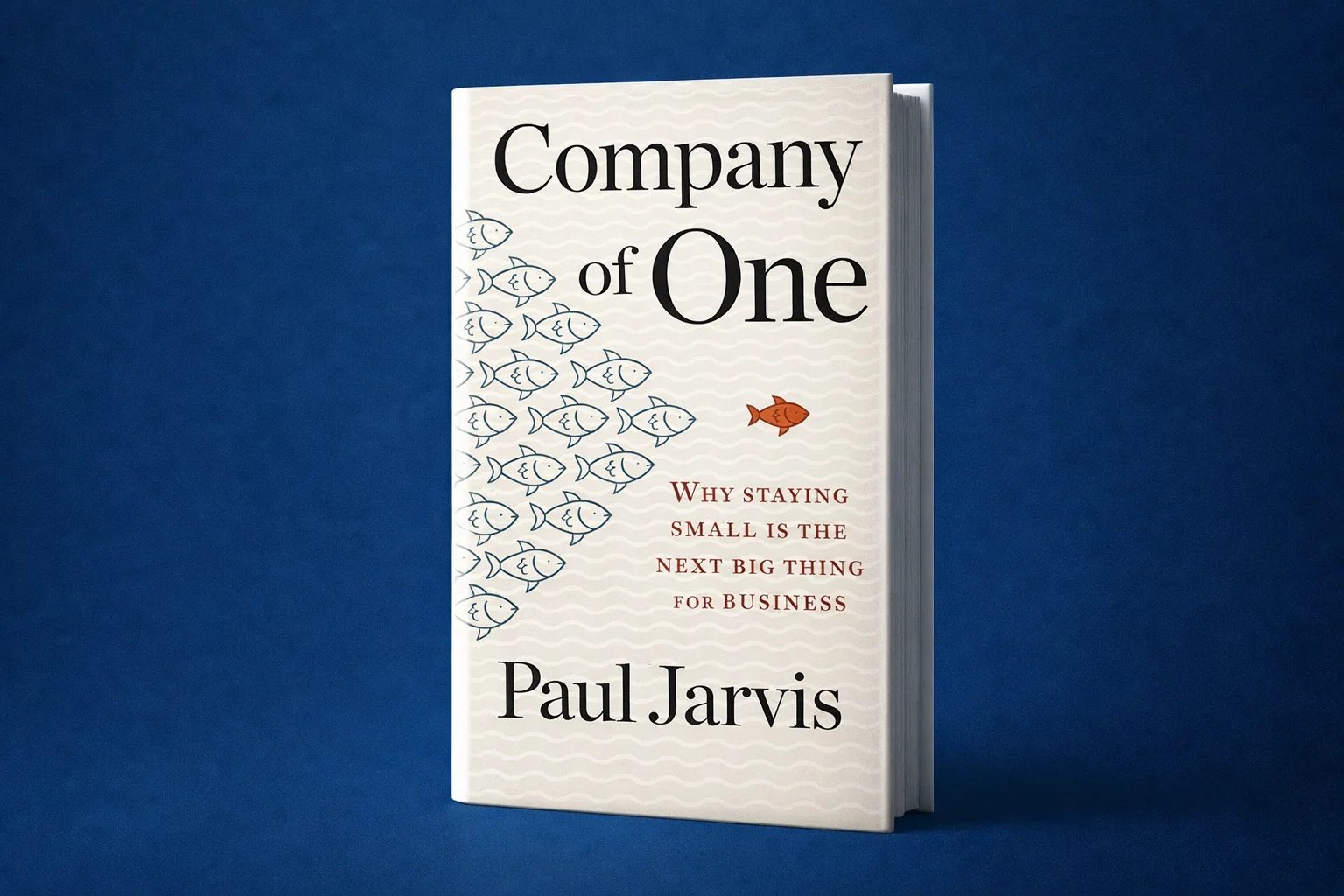
In the relentless drumbeat of modern business, the message is clear: grow or die. Paul Jarvis offers a compelling counter-narrative: a manifesto for a saner way to work and live by staying small by choice.
In a world obsessed with scaling bigger, hiring faster, and expanding wider, what if this constant chase for “more” is actually a trap? In his book, Company of One, Paul Jarvis explains that the path to a more profitable, resilient, and enjoyable business isn’t about getting bigger, but about getting better. This philosophy was born from his own journey of swapping a hyperconnected city life for a remote town to escape the “business as usual” mindset.
1. What is a “Company of One”?
A “company of one” is a business that actively resists conventional growth to focus on being better, not bigger. It is a framework for building a business that intentionally questions the scale-at-all-costs mandate, designing work to fit a desired life—not the other way around.
It’s a Mindset, Not a Business Size
A company of one isn’t strictly defined by the number of employees. It can be a single person or a small, dedicated team. The defining characteristic is its mindset: it purposefully chooses to stay small to remain self-reliant and responsible for its own path. Unlike most small businesses whose ultimate goal is expansion, a company of one sees staying small as a strategic advantage.
Beyond Freelancing
While freelancing is often a great first step, a company of one operates on a different model. A typical freelancer trades time directly for money; if they aren’t actively working, they aren’t earning. In contrast, a company of one focuses on building systems and processes that create value beyond a one-to-one exchange of time.
The Three Simple Rules
Jarvis boils down the core ideology into three foundational rules:
- Start small
- Define growth
- Keep learning
2. The Hidden Perils of the ‘Growth at All Costs’ Mindset
The book highlights the hidden costs and risks of chasing scale for its own sake, challenging the default assumption that constant growth is always good.
The “Disease of More”
Coined by legendary coach Pat Riley, the “disease of more” describes the mindset that pushes successful businesses to chase more revenue and employees—often at the expense of what made them successful. This pursuit can lead to burnout, brand dilution, and financial instability.
Cautionary Tales of Unchecked Scaling
- Danielle LaPorte’s “Beast”: After investing in a million-dollar website to reach the “next level,” the site became a “Beast” that required a massive team to feed, pulling her focus away from her creative work.
- Buffer’s Hiring Frenzy: The company hired aggressively based on projected revenue targets. When capital couldn’t support the payroll, they were forced into painful layoffs.
- Brand Dilution (Starbucks & Krispy Kreme): Starbucks diluted its core experience by over-expanding into sandwiches and CDs. Krispy Kreme destroyed its “scarcity value” by moving into grocery stores, leading to an 18% drop in sales.
3. The Power of Defining “Enough”
The alternative to the “disease of more” is to set an upper bound for growth—to consciously decide what is “enough.”
The Surfer Accountant & Sean D’Souza
- The Surfer Accountant: Jarvis shares the story of a friend who calculated exactly how much profit he needed. Once he hit that number in August, he stopped taking on work and spent the rest of the year rock climbing.
- Sean D’Souza’s $500,000 Cap: The founder of Psychotactics deliberately limits his company’s annual profit. This cap allows him to focus on quality and maintain a lifestyle that includes a three-month vacation every year.
4. Pillars of a Resilient Small Business
Several key principles allow a small, focused business to not just survive, but thrive.
Autonomy Through Mastery
True autonomy is tied to competence. Tom Fishburne left a high-paying corporate role to become a cartoonist—earning much more—because he was a master of his craft. Freedom wasn’t a whim; it was a calculated outcome of mastery.
Your Best Marketing is a Successful Customer
The most sustainable path to profit isn’t chasing new leads; it’s obsessing over the success of your existing customers.
- The Personal Touch: Sean D’Souza sends customers a simple $20 box of chocolates. People talk about that gift more than his $2,000 training programs.
- Customer Innovation: Research shows over 60% of profitable innovations originate with customers.
Your Personality is Your Brand
In a crowded market, your authentic personality is a strategic advantage.
- Polarization: Trying to appeal to everyone appeals to no one.
- Examples: Marie Forleo built a massive tribe through her quirky personality. Marmite used the tagline “You either love it or hate it” to turn polarization into a marketing masterstroke.
How to Build Your Company of One
- Start with the Smallest Viable Version: Focus on a “Minimum Viable Profit.” Don’t obsess over logos or office space; master your core value proposition first.
- Teach Everything You Know: Build trust by sharing knowledge freely (like Brian Clark of CopyBlogger).
- Fund It Without VCs: Use crowdfunding to validate ideas and keep control. (e.g., Ugmonk’s “Gather” raised $430k on Kickstarter without giving up equity).
Conclusion
Company of One is a cultural corrective to “hustle culture.” Jarvis makes a logical and profitable case for staying small by choice. The ultimate goal should be to support the life you want to live, not to create a life that is consumed by the endless demands of your business.
About the Author: Paul Jarvis
Paul Jarvis is a veteran designer and tech consultant who has worked with professional athletes (like Shaq and Steve Nash) and global brands (like Microsoft and Mercedes-Benz). Today, he spends his time writing, creating software, and teaching online courses through his own “company of one,” Mighty Small Ventures. He lives on an island off the coast of British Columbia and is a leading voice for sustainable, independent entrepreneurship.
Book Details
- Title: Company of One: Why Staying Small Is the Next Big Thing for Business
- Author: Paul Jarvis
- Publisher: Houghton Mifflin Harcourt
- Publication Date: January 15, 2019
- Print Length: 272 pages
- Category: Business Strategy / Entrepreneurship / Self-Help